
PreNUDGE FHIR® IG for Data Provider / Data from Apps (R4)
0.1.0 - ci-build
PreNUDGE FHIR® IG for Data Provider / Data from Apps (R4)
0.1.0 - ci-build
PreNUDGE FHIR® IG for Data Provider / Data from Apps (R4) - Local Development build (v0.1.0) built by the FHIR (HL7® FHIR® Standard) Build Tools. See the Directory of published versions
The transmission of health profile data from the qualified apps to the PreNUDGE platform is optional.
Health profile data will only be sent once citizens establish the connection within the app and give their consent. See section App Pairing for more.
Before health profile data reaches PreNUDGE, the FHIR Master Patient Index (MPI) module (via Reverse Proxy) creates an App Patient from the token's Subject-ID, links it to a protected Person resource via Person.link, and shields sensitive identity data from apps. See section Patient Identity Provisioning and MPI Resolution for more.
After the app pairing and the patient identity provisioning is successfully completed, the mobile application can communicate with the PreNUDGE platform through standard FHIR RESTful interactions that must comply with this Implementation Guide (IG). See FHIR Communication for more.
Additional there are current and planned requirements for data providers, see Dataprovider Qualification Matrix for more.
This sequence describes the process of a citizen connecting their mobile application to the PreNUDGE platform using ID-Austria for identity verification and authorization.
Observation, QuestionnaireResponse, etc.).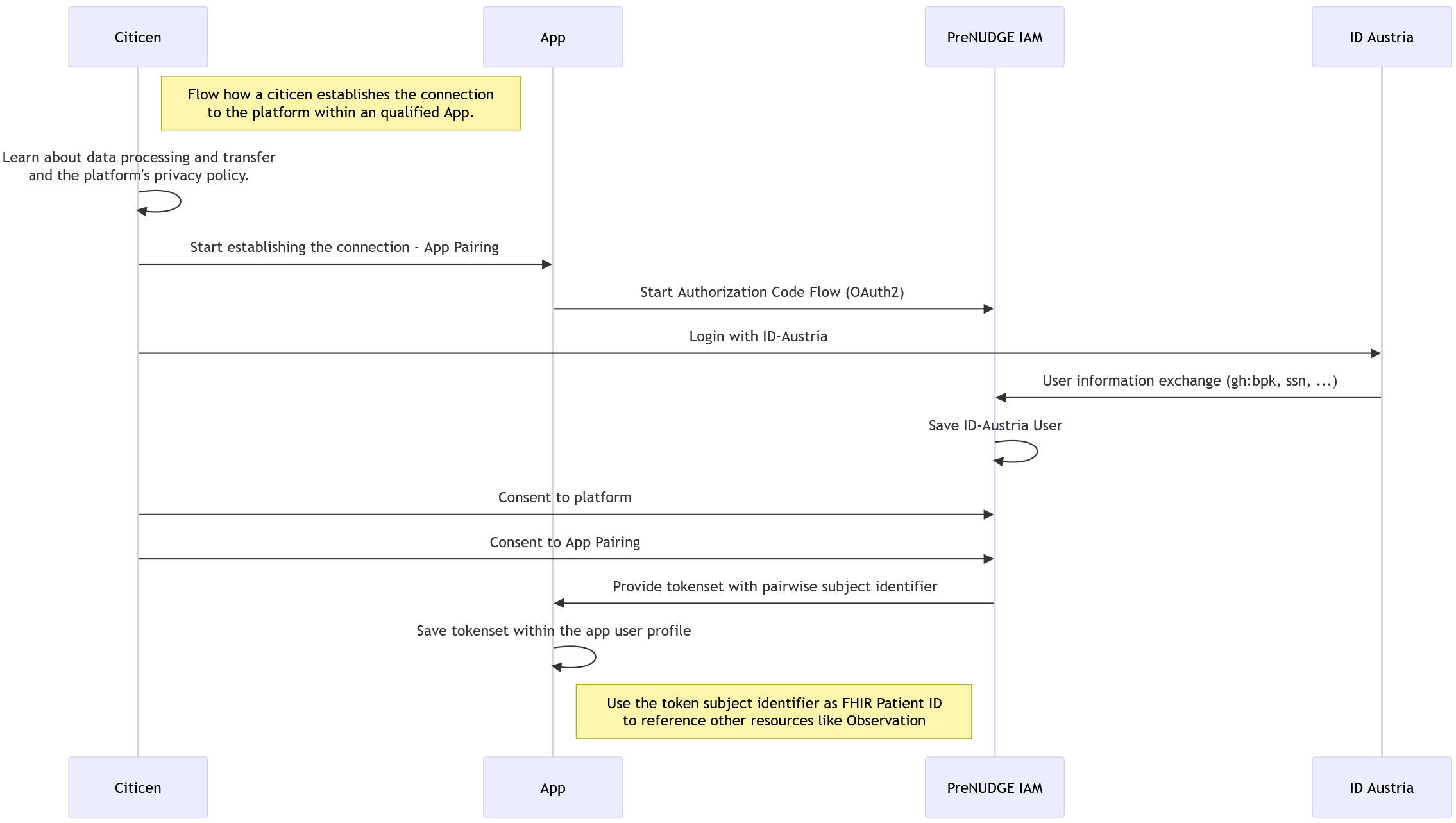
Before health profile data can be sent to the PreNUDGE platform, a dedicated App Patient must be created. The Subject-ID from the token set is used as the FHIR Resource ID for the Patient. Additionally, a Person resource is created with the citizen's identification details, and the relationship between Person and Patient is established via Person.link. This logic is implemented in the PreNUDGE FHIR MPI module. The FHIR MPI module is integrated into the request flow via the Reverse Proxy configuration. For better readability, the Reverse Proxy is not shown in the flow diagram. To ensure maximum confidentiality of sensitive identity data, the Person resource is protected before access by applications.
This sequence describes how the FHIR MPI (Master Patient Index) ensures that a patient identity exists and is correctly linked to a person record before processing clinical resource requests.
Patient/d622...) for all resource references.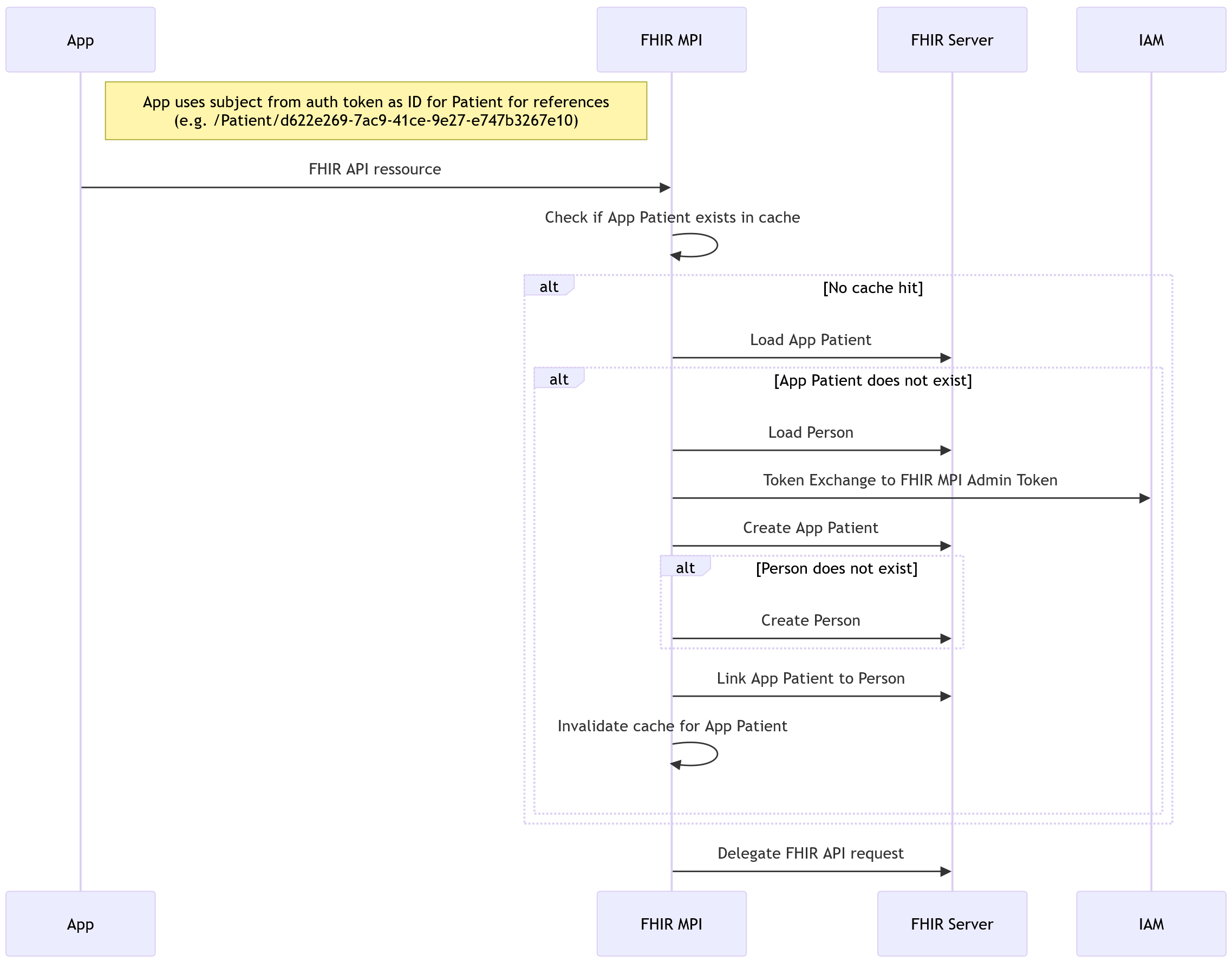
Using the obtained access token, the app can perform authorized operations such as:
GET /Patient/{id}, GET /Observation?patient={id})All interactions MUST conform to the specifications, resource profiles, and security guidelines defined in this Implementation Guide (IG) to ensure compliance, interoperability, and data integrity.
These interactions follow the HL7® FHIR R4 REST API principles, ensuring full interoperability and secure data exchange between the citizen's app and the platform.